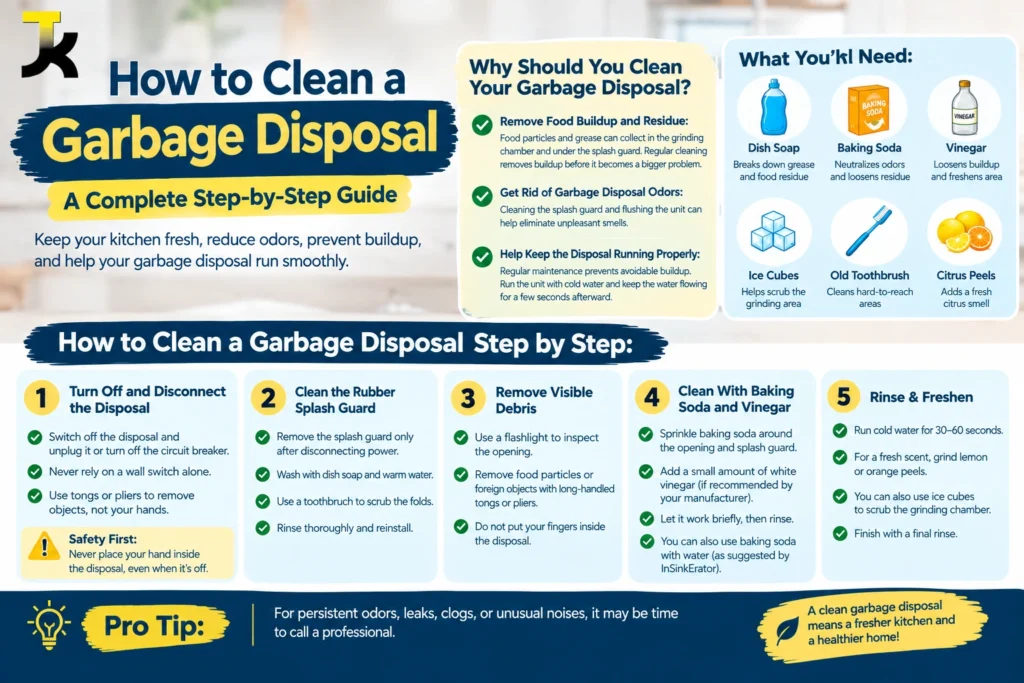
Summary
Regular garbage disposal cleaning removes food residue, reduces unpleasant odours, and helps prevent buildup around the splash guard and grinding chamber. A simple routine of cold-water flushing, weekly cleaning, and monthly deep cleaning can keep the unit fresher. If you have persistent odours, leaks, clogs, unusual noises, or a disposal that will not turn on, professional service may be needed.
How to Clean a Garbage Disposal Safely and Effectively:
A garbage disposal makes kitchen cleanup easier, but food particles, grease, and residue can collect inside the grinding chamber and under the rubber splash guard. That buildup can eventually create unpleasant odours or affect how the unit drains and grinds food. Learning how to clean a garbage disposal safely can help keep your sink area fresher and your appliance working properly.
This guide explains safe garbage disposal cleaning methods, including baking soda, vinegar, ice, cold water, dish soap, and citrus peels. You will also learn how often to clean the unit, what should never go into it, and when professional help may be more appropriate.
Why Should You Clean Your Garbage Disposal?
A disposal does not clean itself completely every time it runs. Small food particles can remain around the chamber and beneath the splash guard. Manufacturer guidance also notes that food buildup can be a common cause of disposal odours.
Remove Food Buildup and Residue:
Food particles can collect in areas that water does not fully reach. Greasy residue can also stick to surfaces and contribute to unpleasant smells. Regular cleaning helps remove this buildup before it becomes a larger problem.
Get Rid of Garbage Disposal Odours:
A bad smell often means food waste has remained inside the disposal or beneath the baffle. Cleaning the splash guard and flushing the unit can address many ordinary odour problems.
Help Keep the Disposal Running Properly:
Regular maintenance does not replace repairs, but it can help prevent avoidable buildup. Running the unit with a moderate stream of cold water and continuing the water flow for a few seconds afterward is recommended by disposal manufacturers.
What You Need to Clean a Garbage Disposal:
You do not need many supplies for routine cleaning. These common household items can help with residue, odours, and surface buildup.
| Cleaning Item | Purpose |
| Dish soap | Breaks down grease and food residue |
| Baking soda | Helps neutralise odours and loosen residue |
| White vinegar | Helps loosen some buildup and freshen the area |
| Ice cubes | Helps scrub the grinding area |
| Old toothbrush | Cleans hard-to-reach areas |
| Lemon or orange peels | Adds a fresh citrus smell |
Always check your disposal manufacturer’s instructions before using a particular cleaning method. Some manufacturers specifically recommend baking soda, citrus, and ice while warning against bleach and chemical drain cleaners.
How to Clean a Garbage Disposal Step by Step:
If you are looking for the best way to clean a garbage disposal, start with safety. Never place your hand inside the disposal, even when the unit appears to be switched off.
1. Turn Off and Safely Disconnect the Disposal:
Switch off the disposal and disconnect its power before cleaning inside the sink opening or handling the splash guard. If the unit is hardwired, turn off the appropriate circuit breaker.
Never assume that a wall switch alone makes the appliance safe to handle. Manufacturer safety instructions also advise using tongs or pliers to remove objects rather than reaching into the disposal.
2. Clean the Rubber Splash Guard:
The splash guard is one of the most commonly overlooked areas. Food residue can collect underneath its folds. If your model has a removable splash guard, remove it only after the power has been disconnected. Wash it with dish soap and warm water, then use an old toothbrush to scrub around the folds. Rinse it thoroughly before reinstalling it.
3. Remove Visible Food Debris:
Use a flashlight to inspect the opening. If you see a food particle or foreign object, use long-handled tongs or pliers to remove it. Do not put your fingers into the disposal. Even when cleaning is your only goal, this is an unnecessary safety risk.
4. Clean the Disposal With Baking Soda and Vinegar:
Sprinkle baking soda around the sink opening and splash guard area. You can follow it with a small amount of white vinegar if this is compatible with your manufacturer’s instructions. Allow the mixture to work briefly, then rinse the area. Baking soda can also be used with water as part of a disposal-cleaning process recommended by InSinkErator. This approach is part of several natural garbage disposal cleaning methods, but it should not be treated as a cure for mechanical problems.
5. Flush the Disposal With Cold Water:
Turn on a moderate stream of cold water and run the disposal according to the manufacturer’s instructions. Continue running cold water for several seconds after grinding. Cold water is recommended during normal disposal operation because it helps carry food waste through the drain.
6. Clean the Grinding Chamber With Ice:
Ice cubes can provide a light scrubbing action as they move through the grinding chamber. Run cold water and use the amount of ice recommended for your particular disposal. Some manufacturers specifically recommend ice as part of routine disposal care.
7. Freshen the Disposal With Citrus Peels:
Small pieces of lemon or lime peel can help freshen the drain area. Some manufacturers specifically recommend citrus peels as a way to freshen disposal smells. Avoid putting large quantities of peel into the unit at once. The goal is freshness, not filling the disposal with additional waste.
How to Clean a Garbage Disposal That Smells
If you are wondering how to remove bad smells from a garbage disposal, start by looking beneath the splash guard. Food buildup in this area is easy to miss.
Use Baking Soda and Vinegar:
Baking soda can help freshen the disposal and loosen residue. Vinegar may be used as an additional household cleaning ingredient, provided your disposal manufacturer does not prohibit it.
Clean Under the Splash Guard
Remove or lift the splash guard according to your model’s instructions and clean both sides. Odour-causing food particles can remain underneath the rubber folds.
Flush With Cold Water
A proper water flush helps carry loosened food particles through the drain. Continue the flow for several seconds after the disposal finishes grinding.
Use Citrus Peels for Freshness
Lemon, lime, or orange peels can provide a temporary fresh scent. Remember that citrus does not replace cleaning when there is significant food buildup.
How to Clean the Rubber Splash Guard:
After disconnecting the power, remove the splash guard if your model allows it. Wash the top and underside with dish soap and warm water.
Pay particular attention to the folds where small pieces of food can hide. An old toothbrush works well for narrow areas. Rinse the guard thoroughly and reinstall it securely. Some disposal models have integrated splash guards that are not designed to be removed. In that case, clean the accessible surfaces without forcing the part out.
How to Clean a Garbage Disposal Without Vinegar
Not everyone wants to use vinegar, and it is not essential to every cleaning routine.
Baking Soda and Hot Water:
Baking soda can be used to freshen the disposal and help loosen residue. Use warm water for the cleaning process, but remember that manufacturers generally recommend cold water while grinding food waste.
Ice and Cold Water
Ice and cold water provide a simple physical cleaning method. The ice can help scrub the grinding area while water carries loosened particles away.
Dish Soap and Cold Water
A small amount of dish soap can help break down surface grease around the sink opening and splash guard. Always flush thoroughly afterward.
Citrus Peels
Citrus peels are useful when your main goal is freshness rather than heavy cleaning.
How Often Should You Clean a Garbage Disposal?
The answer to how often should you clean a garbage disposal depends on how frequently you use it and how much food waste goes through it.
| Cleaning Task | Suggested Frequency |
| Quick water flush | After each use |
| Basic cleaning | Weekly |
| Deep cleaning | Monthly |
| Splash guard cleaning | Weekly or as needed |
| Odour treatment | Whenever unpleasant smells develop |
A short flush after normal use is one of the easiest maintenance habits. For deeper cleaning, a weekly routine is practical for many households.
What Not to Put Down a Garbage Disposal:
Good disposal habits are just as important as cleaning.
Grease and Cooking Oil:
Never pour grease, fat, or cooking oil into the disposal or drain. These materials can accumulate in plumbing and contribute to blockages.
Fibrous Foods:
Large amounts of stringy or fibrous food can be difficult for some disposals to process. Follow the instructions for your specific model.
Coffee Grounds:
Coffee grounds can accumulate in plumbing rather than simply disappearing through the disposal.
Eggshells:
Avoid treating eggshells as a routine disposal cleaner unless your manufacturer’s instructions specifically allow them.
Bones and Hard Food Scraps:
Some disposal manufacturers allow certain small hard materials, while others may have different recommendations. Always follow your model’s manual instead of assuming every hard food item is safe.
Common Garbage Disposal Cleaning Mistakes:
Avoid these common mistakes:
- Using harsh chemical drain cleaners
- Putting hands inside the disposal
- Pouring excessive grease or oil into the sink
- Ignoring the splash guard
- Running the disposal without enough water
- Putting large amounts of food waste through at once
Manufacturers specifically warn against bleach and chemical drain cleaners because they may damage the disposal or create safety issues.
How to Maintain a Clean Garbage Disposal:
Good maintenance is easier than dealing with a neglected disposal. Run cold water while using the unit, feed food waste gradually, and keep the splash guard clean.
For homeowners researching garbage disposal maintenance in Vancouver, the same basic principles apply: use the disposal correctly, flush the drain after grinding, avoid grease, and inspect the unit for leaks or unusual changes in performance.
Regular kitchen sink cleaning in Vancouver routines should also include the disposal opening, sink drain, splash guard, and surrounding cabinet area.
When Should You Call a Plumber?
Cleaning can handle ordinary food residue and mild odours, but it cannot fix every disposal problem.
Consider professional help when you notice:
- Persistent odours after thorough cleaning
- Water leaking beneath the unit
- Frequent clogs
- Unusual grinding, humming, or rattling noises
- Poor grinding performance
- A disposal that will not turn on
- Repeated jams or electrical trips
If you are looking for garbage disposal repair in Vancouver, a qualified plumber or appliance professional can inspect the unit and determine whether repair, replacement, or drain work is needed.
For broader household needs, professional providers may also offer garbage disposal service in Vancouver, garbage disposal waste removal in Vancouver, kitchen waste removal in Vancouver, or residential waste removal depending on the type of work required.
Professional Cleanup and Waste Removal Services
Garbage disposal cleaning is different from removing accumulated household waste. If your property also needs overflowing garbage cleanup, property cleanup, or household cleanup service, a professional team may be able to handle the larger cleanup separately.
Depending on the provider, what a professional cleaning service can clean may include kitchens, bathrooms, common areas, accumulated household waste, and other property areas.
Some companies also provide property cleanup and waste removal, waste collection and disposal, or garbage hauling and disposal. For larger projects, services can extend to a post-renovation cleaning service or construction cleanup service.
If you are comparing garbage removal Vancouver, junk removal Vancouver, residential garbage removal Vancouver, or appliance removal Vancouver, check exactly what materials the provider accepts. Some companies specialise in garbage pickup in Vancouver or garbage hauling in Vancouver, while others focus on bulky items or property cleanouts.
For related local information, see our guide on How Much Does Garbage Removal Cost in Vancouver?
What Is Included in a Deep Cleaning Service?
A deep cleaning service generally goes beyond routine surface cleaning. Depending on the provider and property, it may include detailed kitchen cleaning, hard-to-reach areas, accumulated dirt, and other household surfaces. When comparing professional cleanup solutions, ask what is included before booking. Pricing and scope vary based on the property size, amount of waste, labour, and type of material.
Frequently Asked Questions
How do you clean a garbage disposal?
Start by turning off and disconnecting the power. Clean the splash guard, remove visible debris with tongs or pliers, use an appropriate cleaning method, flush with cold water, and finish with ice or citrus if recommended for your model.
What is the best thing to use to clean a garbage disposal?
Baking soda, water, dish soap, ice, and citrus can all be useful for different cleaning tasks. The safest choice depends on your disposal manufacturer’s instructions.
How do you get rid of a bad smell in a garbage disposal?
Clean underneath the splash guard, remove food residue, flush the disposal with cold water, and use baking soda or citrus to freshen the unit. If the smell remains, there may be a clog, buildup, or plumbing problem.
Can you put baking soda and vinegar in a garbage disposal?
Baking soda can be used to freshen a disposal, and some homeowners use vinegar as part of household cleaning. However, follow the manufacturer’s care instructions for your specific unit rather than assuming every homemade cleaner is appropriate.
How often should you clean a garbage disposal?
A quick water flush should happen after normal use. A basic cleaning once a week and a deeper cleaning about once a month is a practical routine for many households.
Can you clean a garbage disposal with ice?
Yes. Ice is recommended by some manufacturers as part of disposal cleaning because it can provide a scrubbing action inside the grinding chamber.
How do you clean underneath a garbage disposal splash guard?
First disconnect the power. If the splash guard is removable, take it out according to the manufacturer’s instructions and scrub both sides with dish soap and warm water. If it is integrated, clean the accessible folds without forcing it out.
How much does a garbage cleaning service cost?
The cost depends on whether you need simple cleaning, household waste removal, bulky-item removal, or a larger property cleanup. For accurate local pricing, compare providers based on the exact work and amount of waste involved.
What items can a garbage cleaning service remove?
Accepted items vary by provider. Ask whether they handle household waste, appliances, bulky items, renovation debris, or other materials before scheduling service.
Can garbage cleaning services remove bulky items?
Some junk removal and property cleanup companies do accept bulky items, but restrictions can apply. Confirm accepted materials, size limits, and disposal fees beforehand.
Can garbage cleaning services remove household waste?
Many residential waste removal providers handle household waste, but the exact materials accepted vary. This may include bagged household waste, unwanted items, or property-cleanup debris depending on the company.
How is garbage collected and disposed of?
Garbage is generally collected through municipal or private collection systems and transported for processing, recycling, transfer, treatment, or disposal depending on the material and local regulations.
How often should garbage be removed?
Regular household garbage should be removed according to your local collection schedule, and sooner if waste begins creating odours, pests, or an overflowing container.
When should you hire a cleaning service?
Consider professional help when the cleanup is too large to handle safely, involves significant accumulated waste, requires bulky-item removal, or forms part of a larger property cleanup.
Who provides garbage cleaning services near me?
For local service, search for providers offering garbage removal Vancouver, garbage pickup Vancouver, garbage hauling Vancouver, or related residential cleanup services and compare their accepted materials and pricing.
Final Thoughts
Knowing how to clean a garbage disposal can help you control food buildup, reduce odours, and keep your kitchen sink area fresher. The most important habits are simple: use cold water during grinding, flush the drain afterward, clean the splash guard regularly, and avoid grease or inappropriate waste.
For homeowners who need more than routine appliance cleaning, professional property cleanup and waste removal can handle larger household cleanup needs. If the disposal leaks, jams repeatedly, makes unusual noises, or will not start, stop using it and arrange appropriate professional service rather than trying to solve a mechanical problem with cleaning products. For a detailed visual reference, see our step-by-step garbage disposal cleaning guide.